
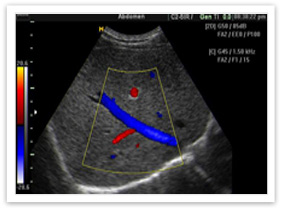
Color Doppler
This is a type of ultrasound scan designed to measure blood flow, using black and white or colour images. It can be used to see if the blood flow in your womb, placenta and your baby's brain is adequate by tracing the blood flow patterns in these areas.
| Why might I need a Doppler scan?
A Doppler scan is most commonly used to see if your placenta is working normally, by tracing the blood flow between the placenta and your baby through the umbilical cord. Your baby is attached to the placenta by the umbilical cord, which has two arteries and a vein. Blood from the placenta carries essential nutrients and oxygen to the baby and takes waste products back through the umbilical cord. |
 |
Smoking temporarily affects the blood flow to your baby. The resistance in the baby's arteries may be raised for about half an hour after her mother has had a cigarette. (Read more about the risks of smoking in pregnancy.)
A small baby who is found to have normal umbilical arteries by a Doppler scan is most probably getting all the nutrients she needs.
You may also be offered a Doppler scan if there are any concerns about your baby's growth, or if you are suffering from high blood pressure or pre-eclampsia, as this may affect the blood flow to your baby.
What is a cardiotocograph?
A form of Doppler ultrasound, known as a cardiotocograph (CTG) or a non stess test (NST), can be used to monitor your baby's heartbeat. A healthy baby's heart rate varies from beat to beat and increases when the baby moves. If you are feeling your baby moving regularly during the day, it is most likely to be fine. Tell your doctor if your baby's movements slow down. To know more about a cardiotocograph and how it is done, read our expert answer on cardiotocography.